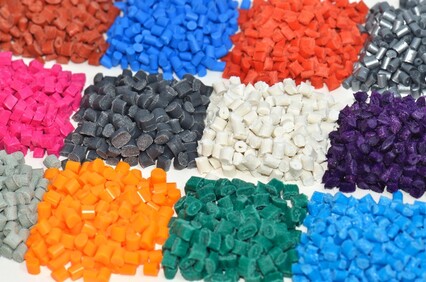
Polycarbonate (PC) is the go-to plastic when a part must be transparent and nearly unbreakable. Roofing sheets, LED covers, electrical housings, safety visors and 20-litre water jars are all common PC applications. This guide covers the grades, properties and buying points for polycarbonate granules.
Key Properties
- Very high impact strength – far tougher than PMMA, glass or SAN.
- Transparency – light transmission of roughly 88–90% in clear grades.
- Heat resistance – heat deflection temperature typically around 130–140°C.
- Dimensional stability – low shrinkage, good for precise parts.
- Self-extinguishing behaviour, with FR grades for electrical use.
- Limitations: scratches more easily than PMMA, needs UV stabilisation outdoors, and can stress-crack with some chemicals.
Density is about 1.20 g/cm³.
Common PC Grades
| Grade | Typical use |
|---|---|
| General purpose | Housings, consumer products, technical parts |
| Optical / LED | Lenses, light guides, LED diffusers |
| UV-stabilised / sheet grade | Multiwall and solid roofing sheets, glazing |
| Flame retardant (FR) | Electrical enclosures, switchgear, chargers |
| Glass-filled | Stiff structural parts, brackets |
| Blow-moulding / bottle grade | Large water jars and containers |
Where PC Is Used
- Construction: polycarbonate roofing and skylight sheets.
- Electrical and electronics: meter covers, MCB housings, connectors, charger bodies.
- Lighting: LED bulb covers, street-light diffusers.
- Automotive: headlamp lenses (with hard coating), interior parts.
- Safety: face shields, visors, protective guards.
Drying Is Critical
PC is very sensitive to moisture during processing. Moisture causes hydrolysis, which lowers molecular weight and makes parts brittle even if they look fine. Dry granules at about 120°C for 3–4 hours in a dehumidifying dryer to below 0.02% moisture, and use a hopper dryer so material does not pick up moisture again.
PC vs PMMA vs PC/ABS
- Choose PC for toughness and heat resistance.
- Choose PMMA for clarity, scratch resistance and outdoor stability at lower cost.
- Choose PC/ABS for opaque housings needing toughness and easier processing.
Buying Tips
- Much of the PC used in India is imported – check stock and lead time, not just price.
- Ask for the TDS: MFI (300°C / 1.2 kg), HDT, impact, and flame rating where relevant.
- For food-contact or water-jar use, ask for the relevant compliance certificate.
- Confirm whether the material is prime, off-grade or regrind – it matters a lot for clarity and toughness.
Check availability on our Polycarbonate product page.
Get a Quote
Share the grade (or your current grade name), monthly quantity, delivery city and payment terms, and the Granil PolyTrade team will come back with today's rate and availability. Request a quote or register as a buyer.