Virgin vs Reprocessed Polymer Granules – Which is Better?
Polymer granules are the foundation of the plastic manufacturing industry. In India, industries use both virgin polymer granules and reprocessed polymer granules depending on product requirements, quality expectations, budget, and industrial applications.
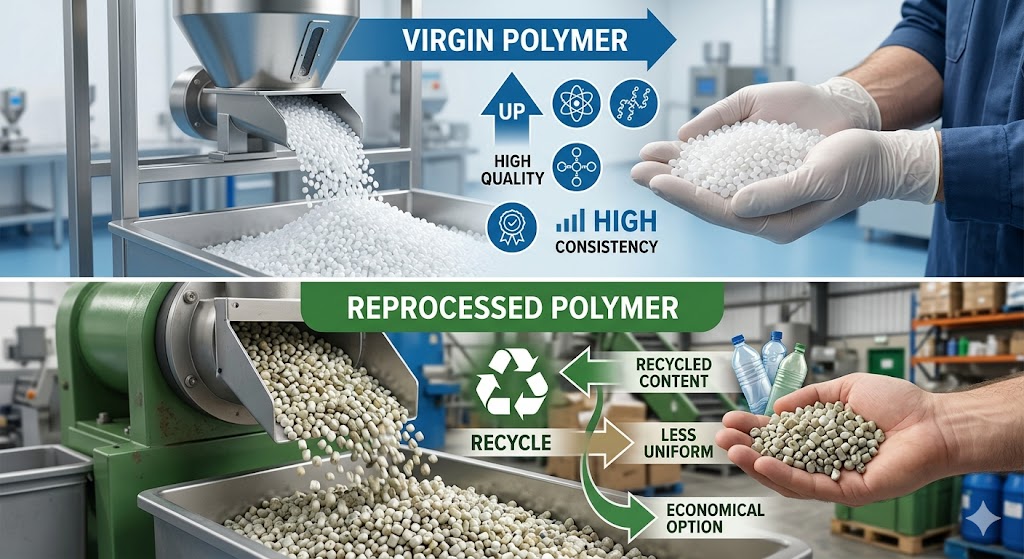
Virgin polymer granules are manufactured directly from petrochemical raw materials, while reprocessed polymer granules are produced from recycled plastic waste and scrap materials.
Both materials have their own advantages, disadvantages, pricing benefits, quality differences, and industrial applications.
Companies like Granil PolyTrade support industries across India by supplying both virgin and reprocessed polymer raw materials for packaging, molding, infrastructure, recycling, footwear, automotive, and industrial manufacturing applications.
What are Virgin Polymer Granules?
Virgin polymer granules are newly manufactured plastic raw materials produced directly from petrochemical feedstocks such as crude oil and natural gas.
These granules are manufactured in large petrochemical plants by companies such as:
- Reliance Industries
- IOCL
- GAIL India
- OPaL
- Haldia Petrochemicals
- Chemplast Sanmar
Common virgin polymer materials include:
- PP Granules
- HDPE Granules
- LLDPE Granules
- LDPE Granules
- PVC Resin
- PET Resin
- EVA Material
- ABS Granules
What are Reprocessed Polymer Granules?
Reprocessed polymer granules are manufactured from used plastic products, industrial plastic waste, rejected molded products, plastic films, bottles, packaging materials, and other recyclable plastic scrap.
The scrap plastic is cleaned, sorted, melted, filtered, and converted into reusable granules through recycling and reprocessing machinery.
Reprocessed granules are widely used in:
- Utility products
- Packaging applications
- Industrial molded products
- Construction materials
- Recycled plastic products
- Cost-sensitive manufacturing
Main Difference Between Virgin and Reprocessed Polymer Granules
| Factor | Virgin Polymer Granules | Reprocessed Polymer Granules |
|---|---|---|
| Raw Material Source | Crude oil & natural gas | Plastic scrap & recycled waste |
| Quality | High consistency | Variable depending on recycling quality |
| Strength | Higher mechanical strength | Lower compared to virgin material |
| Purity | Very high purity | May contain minor impurities |
| Price | Higher cost | More economical |
| Appearance | Better finish & color consistency | May vary in finish |
| Environmental Impact | Higher carbon footprint | Environment-friendly recycling option |
| Industrial Usage | Premium applications | Utility & commercial applications |
Advantages of Virgin Polymer Granules
1. Better Strength and Durability
Virgin granules provide higher tensile strength, impact resistance, and long-term durability compared to recycled materials.
2. Consistent Quality
Virgin polymers maintain consistent molecular structure, color, melt flow, and processing performance.
3. Better Surface Finish
Products manufactured using virgin granules usually have smoother finish, better appearance, and uniform texture.
4. Food Grade & Medical Applications
Virgin materials are preferred for food packaging, pharmaceutical, and medical applications because of higher purity.
5. Better Processing Performance
Virgin granules provide stable processing during injection molding, extrusion, and blow molding operations.
Disadvantages of Virgin Polymer Granules
1. Higher Cost
Virgin polymer granules are significantly more expensive than reprocessed materials.
2. Higher Environmental Impact
Virgin plastic manufacturing depends heavily on crude oil and petrochemical processing, increasing carbon emissions.
3. Dependence on Crude Oil Prices
Prices of virgin polymers fluctuate based on global crude oil markets and international supply conditions.
Advantages of Reprocessed Polymer Granules
1. Lower Cost
Reprocessed granules are more economical and help manufacturers reduce production costs.
2. Environment-Friendly
Recycling plastic waste reduces landfill pollution and supports sustainable manufacturing.
3. Reduces Plastic Waste
Plastic recycling helps convert waste materials into reusable industrial raw materials.
4. Suitable for Utility Applications
Reprocessed granules are widely used for products where ultra-premium finish is not required.
5. Supports Circular Economy
Recycling promotes reuse of resources and reduces dependence on virgin petrochemical production.
Disadvantages of Reprocessed Polymer Granules
1. Lower Mechanical Strength
Repeated heating and recycling may reduce polymer strength and performance.
2. Quality Variation
Quality may vary depending on scrap source, cleaning quality, and recycling process.
3. Color Consistency Issues
Reprocessed granules may not provide consistent color and finish compared to virgin materials.
4. Limited High-End Applications
Recycled materials are usually not preferred for critical medical, food-grade, or premium engineering products.
Industries Using Virgin Polymer Granules
- Food packaging industry
- Medical industry
- Automotive industry
- Electronics manufacturing
- Premium consumer products
- Infrastructure applications
- Industrial molding
Industries Using Reprocessed Polymer Granules
- Utility products manufacturing
- Plastic recycling industry
- Construction applications
- Industrial packaging
- Household products
- Agricultural products
- Secondary packaging
Which is Better – Virgin or Reprocessed Polymer?
The answer depends on product requirements, budget, quality expectations, and industrial applications.
| Requirement | Better Choice |
|---|---|
| Premium product quality | Virgin Polymer |
| Low-cost manufacturing | Reprocessed Polymer |
| Food-grade applications | Virgin Polymer |
| Environment sustainability | Reprocessed Polymer |
| High mechanical strength | Virgin Polymer |
| Utility products | Reprocessed Polymer |
Role of Granil PolyTrade in Polymer Supply
Granil PolyTrade supports manufacturers, processors, recyclers, and industrial buyers across India with polymer raw material solutions.
The company supplies:
- Virgin Polymer Granules
- Reprocessed Polymer Granules
- Commodity Polymers
- Engineering Polymers
- Industrial Raw Materials
Businesses can explore material categories through the Products Page or contact the company through the Contact Page.
Conclusion
Both virgin and reprocessed polymer granules play important roles in the modern plastic manufacturing industry.
Virgin polymers provide higher strength, consistency, and premium performance, while reprocessed polymers offer economical and sustainable solutions for many industrial applications.
The right choice depends on product quality requirements, manufacturing costs, environmental priorities, and industrial usage.
Granil PolyTrade continues supporting industries across India with reliable polymer raw material supply solutions for both virgin and recycled polymer applications.