Largest Polymer Companies in India: The Complete 2026 Guide
India's polymer industry has quietly become one of the largest and fastest-growing petrochemical ecosystems in the world. From the massive integrated refinery-cracker complexes on the western coast to the specialised compounding units serving the automotive and electronics sectors, the country's polymer landscape is shaped by a small group of companies whose output decides pricing, availability, and quality for thousands of downstream manufacturers, traders, and exporters.
In this guide, we take a detailed look at the largest polymer companies in India in 2026 — who they are, what they produce, how their capacities compare, and why understanding this landscape matters if you are a plastic processor, packaging manufacturer, construction contractor, or polymer trader trying to plan your raw material sourcing strategy.
Why India's Polymer Industry Matters
India's polymer consumption has been rising steadily on the back of packaging, construction, automotive, agriculture, and consumer electronics demand. Industry estimates put current domestic polymer consumption at roughly 25 million tonnes a year, with projections suggesting this could climb toward 35 million tonnes by the end of the decade as e-commerce, quick-commerce, and infrastructure spending continue to expand. That kind of growth has turned the country into one of the largest polymer demand centres globally, even though it remains a significant net importer of both crude oil and several finished polymer grades.
That import dependence is precisely why the size and capacity of India's own polymer producers matter so much. When domestic capacity is strong, price shocks from global crude oil markets are cushioned to some extent. When domestic capacity falls short, as it does today in categories like PVC, the market becomes far more exposed to global feedstock costs, shipping disruptions, and geopolitical flashpoints such as tensions in West Asia, which have repeatedly pushed up naphtha, LPG, and crude prices in recent years.
How We Defined "Largest" in This List
Ranking polymer companies is not a single-metric exercise. A company can be the largest by installed cracker capacity, by finished polymer output in tonnes per annum, by revenue, by market capitalisation, or by breadth of product portfolio. In this article, we have used a combination of factors:
- Scale of integrated refining and cracker capacity
- Annual polymer production volume across PP, PE, PVC, and specialty resins
- Market share and brand recognition among processors and traders
- Diversity of grades offered (commodity vs engineering plastics)
- Investment in new capacity, R&D, and sustainability initiatives
This gives a more rounded picture than a single revenue or tonnage table, and it reflects how the market itself talks about "the big players" in everyday trading conversations.
The Largest Polymer Companies in India
1. Reliance Industries Limited (RIL)
Reliance Industries is, by almost any measure, the dominant force in India's polymer industry. Its integrated Oil-to-Chemicals (O2C) operations at Jamnagar and Hazira give it unmatched scale, producing polypropylene (PP), the full range of polyethylene grades (HDPE, LLDPE, and LDPE), PVC, and PET. Because Reliance controls the entire value chain from crude refining through to finished polymer granules, it enjoys cost advantages that smaller, non-integrated players cannot easily replicate.
Beyond sheer volume, Reliance has been investing heavily in circular economy initiatives, including recycled and bio-based feedstock polymers, and has announced major capacity additions in PVC to help narrow India's long-standing supply gap in that resin. For most processors and traders, Reliance grades remain the benchmark against which other suppliers are compared.
2. Indian Oil Corporation Limited (IOCL)
IOCL leverages its vast refinery network — including major petrochemical units at Panipat and Paradip — to produce high-grade PP and PE under its well-known "Propel" brand. IOCL's scale as India's largest refiner gives it significant flexibility in feedstock sourcing, and its raffia and blow-moulding grade PP is widely regarded as some of the most consistent in the domestic market. Ongoing cracker expansions mean IOCL's polymer footprint is set to grow further over the next few years.
3. GAIL (India) Limited
GAIL is one of the country's most important gas-based petrochemical producers, running large-scale polymer operations built around natural gas feedstock rather than crude oil derivatives alone. This gives GAIL a somewhat different cost structure compared to naphtha-based crackers, and its HDPE and LLDPE output is a significant contributor to India's overall polyethylene supply, particularly for the pipe, packaging film, and agriculture sectors.
4. Haldia Petrochemicals Limited (HPL)
Based in West Bengal, Haldia Petrochemicals has long been one of eastern India's most important polymer producers, supplying PP and PE to processors across the eastern and northeastern states. HPL's integrated naphtha cracker complex makes it a key regional alternative to the larger western-coast producers, and it plays an important role in keeping freight costs manageable for buyers located away from Gujarat and Maharashtra.
5. ONGC Petro additions Limited (OPaL)
Operating a large dual-feed cracker at Dahej in Gujarat, OPaL is known for its feedstock flexibility — it can process both naphtha and gas-based inputs, which helps insulate its output economics from single-feedstock price swings. OPaL's HDPE, LLDPE, and PP output has become an increasingly important part of the western India supply base since the plant scaled up production.
6. HPCL-Mittal Energy Limited (HMEL)
A joint venture between Hindustan Petroleum and the Mittal Energy Group, HMEL operates a large refinery-petrochemical complex in Punjab. Its polymer division supplies PP into the northern Indian market, giving processors in Punjab, Haryana, and neighbouring states a shorter, more cost-effective supply route compared to sourcing from western or eastern India.
7. Mangalore Refinery and Petrochemicals Limited (MRPL)
MRPL, a subsidiary of ONGC, runs polypropylene operations alongside its core refining business on India's south-western coast. While smaller in polymer volume compared to the majors above, MRPL is an important regional supplier for processors in Karnataka, Kerala, and the wider south Indian market.
8. Brahmaputra Cracker and Polymer Limited (BCPL)
BCPL is a strategically important producer for India's northeastern states, where transportation costs from western or eastern hubs can otherwise be prohibitive. Its polymer output, though modest by national standards, plays an outsized role in supporting the regional plastics processing industry.
9. Supreme Industries Limited
Unlike the refinery-linked producers above, Supreme Industries is primarily a large-scale polymer processor rather than a primary producer — but its scale of consumption and its own value-added product lines (pipes, packaging products, and moulded furniture) make it one of the most recognisable names in the Indian plastics industry. Supreme's purchasing volumes and market presence give it significant influence over how commodity polymer demand trends in India.
10. Finolex Industries Limited
Finolex is one of India's largest PVC pipe manufacturers and also operates its own PVC resin manufacturing capacity, making it a partially integrated player. This dual role — both as a resin producer and a major end-use manufacturer — gives Finolex a distinctive position in the PVC value chain, particularly for the construction and agriculture irrigation sectors.
11. Chemplast Sanmar Limited
Chemplast Sanmar is one of the country's leading specialty chemicals and PVC producers, with a strong presence in suspension and paste PVC grades used in pipes, wires and cables, and footwear. As India continues to run a structural PVC supply deficit, producers like Chemplast Sanmar remain central to efforts to close that gap.
12. DCM Shriram Limited
DCM Shriram's chemicals division includes PVC manufacturing that feeds into the same construction and infrastructure-linked demand pool as Finolex and Chemplast Sanmar. Its integrated chlor-alkali and PVC operations make it a notable, if less commodity-market-visible, contributor to India's overall resin supply.
13. Time Technoplast Limited
Time Technoplast has built a diversified polymer products business spanning industrial packaging, lifestyle products, and infrastructure applications, with a significant appetite for HDPE and other polyolefins as raw material. Its scale of operations across multiple states makes it one of the more prominent polymer-consuming, value-added manufacturing groups in the country.
14. Polyplex Corporation Limited
Polyplex is among India's largest producers of polyester (PET) films, serving packaging, industrial, and electrical insulation applications. While it operates in a more specialised film segment rather than commodity granules, its scale and export orientation place it firmly among India's most significant polymer-linked manufacturers.
15. Jindal Poly Films Limited
Jindal Poly Films is a major producer of BOPP and BOPET films, used extensively in flexible packaging. Its polymer processing volumes are substantial, and the company is frequently cited alongside Polyplex as one of the two dominant Indian players in the polyester and polypropylene film space.
Quick Comparison Table
| Company | Primary Polymer Focus | Key Plant Locations | Market Position |
|---|---|---|---|
| Reliance Industries | PP, PE, PVC, PET | Jamnagar, Hazira | Market leader by scale |
| IOCL | PP, PE | Panipat, Paradip | Leading refiner-linked producer |
| GAIL | HDPE, LLDPE | Pata, Usar | Major gas-based producer |
| Haldia Petrochemicals | PP, PE | Haldia, West Bengal | Leading eastern India supplier |
| OPaL | HDPE, LLDPE, PP | Dahej, Gujarat | Dual-feed flexibility |
| HMEL | PP | Bathinda, Punjab | Leading northern India supplier |
| MRPL | PP | Mangalore, Karnataka | Regional south India supplier |
| BCPL | PP, PE | Lepetkata, Assam | Northeast regional supplier |
| Supreme Industries | PP, PVC (processor) | Multiple states | Largest volume consumer/processor |
| Finolex Industries | PVC | Ratnagiri, Maharashtra | Leading integrated PVC pipe maker |
| Chemplast Sanmar | PVC | Tamil Nadu | Leading specialty PVC producer |
| DCM Shriram | PVC | Bharuch, Kota | Integrated chlor-alkali/PVC player |
| Time Technoplast | HDPE (processor) | Multiple states | Diversified value-added manufacturer |
| Polyplex Corporation | PET film | Uttarakhand, and overseas | Leading PET film exporter |
| Jindal Poly Films | BOPP, BOPET film | Nashik, Uttar Pradesh | Leading flexible film producer |
Key Trends Shaping India's Largest Polymer Producers in 2026
Duty Exemptions and Policy Support
The 2026 Union Budget introduced customs duty exemptions on a number of key petrochemical inputs, which has helped lower feedstock costs for several domestic manufacturers during a period when global crude prices have been volatile. This kind of policy support has a direct bearing on how competitively India's largest producers can price their polymer output against imports.
Sustainability and Recycled Content Mandates
Extended Producer Responsibility (EPR) rules and a broader push toward biodegradable and recycled-content packaging are pushing the largest players to invest in circular polymer streams. Reliance's push into recycled and bio-based feedstocks is one visible example, but mid-sized processors are following the same trajectory as compliance requirements tighten.
Capacity Expansion in PVC
India runs a persistent domestic supply gap in PVC, historically covered through imports. Large new PVC capacity being built out by Reliance and other groups is intended to narrow this gap over the coming years, which should gradually change the competitive balance in the PVC segment specifically.
Export Growth and New Trade Corridors
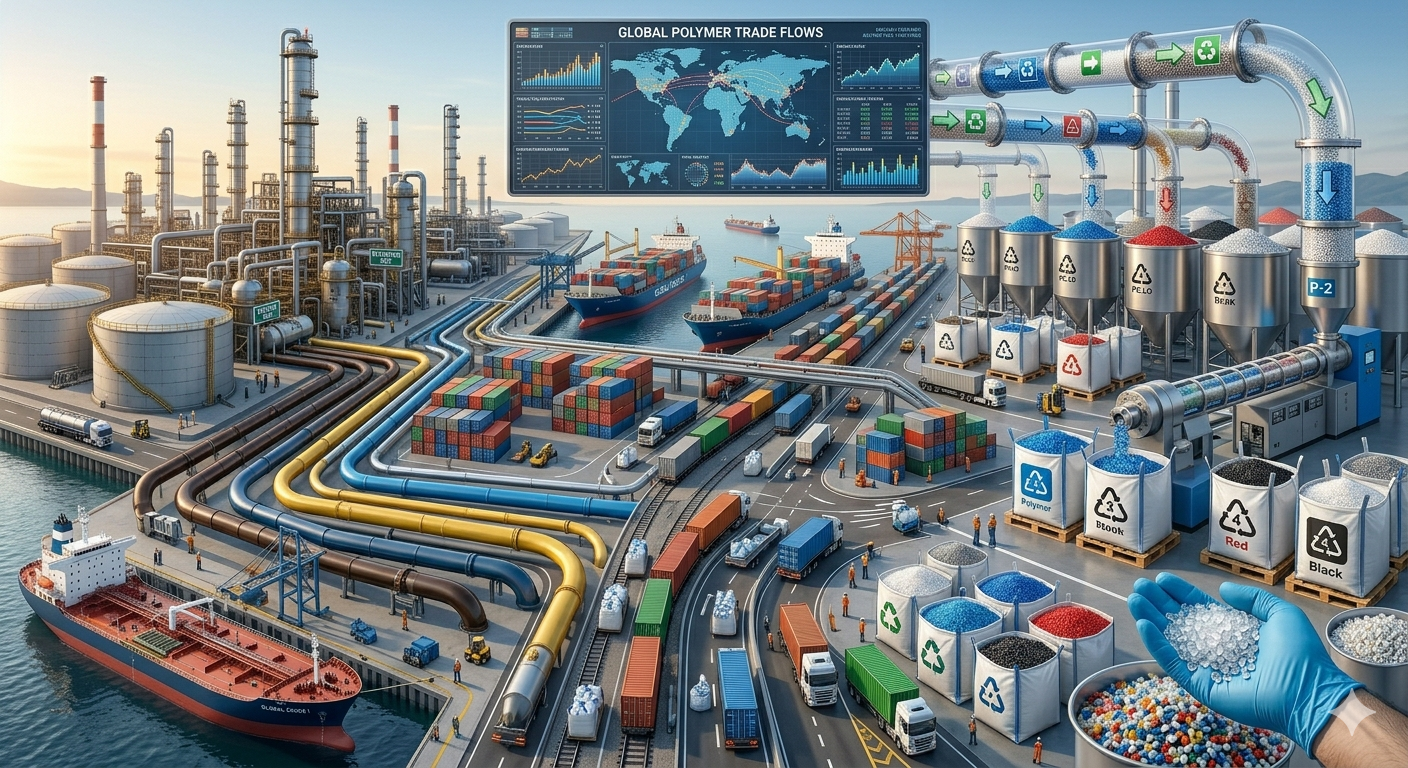
Rising trade flows between India and destinations such as the UAE, alongside growing exports to Europe under emerging carbon-neutrality certification frameworks, are opening new outlets for Indian polymer and polymer-film producers, particularly in PET film and specialty resin categories.
Continued Exposure to Crude Oil Volatility
Because a large share of India's polymer feedstock is either imported crude or naphtha derived from it, geopolitical tensions in oil-producing regions continue to be one of the biggest swing factors in polymer pricing. Periods of sharp crude price increases tend to feed through into higher PP, PE, and PVC prices within weeks, even for buyers sourcing exclusively from domestic producers.
Challenges Facing India's Largest Polymer Companies
- High dependence on imported crude oil and natural gas as feedstock
- Global oversupply and weak margins affecting the broader petrochemical industry
- Rising compliance costs tied to plastic waste and recycling regulations
- Competitive pressure from lower-cost imports, particularly from the Middle East
- Long project execution timelines and high financing costs for new capacity
Industry voices, including senior executives from IOCL, have pointed to India's heavy reliance on imported crude and gas as a structural cost disadvantage compared with producers based in the US and the Middle East, where feedstock is far cheaper. Addressing this gap is likely to remain a long-term priority for policymakers and the largest producers alike.
Why This Matters for Processors and Traders
Whether you run a plastic processing unit, a packaging film business, or a construction materials company, the concentration of India's polymer supply among a relatively small number of large producers has real implications for how you plan procurement. Grade availability, price movements, and regional supply gaps are all shaped by decisions made at this handful of companies — from cracker turnarounds and maintenance shutdowns to new capacity coming online.
This is where working with an experienced polymer trading partner adds real value. Reliable sourcing partners track production schedules, regional pricing differentials, and grade availability across all the major producers, helping processors avoid supply disruptions and secure competitive pricing even during periods of market volatility.
Granil PolyTrade supports manufacturers across India with sourcing assistance for a wide range of polymer materials, including:
- PP Granules
- HDPE Granules
- LLDPE Granules
- LDPE Granules
- PVC Resin
- EVA Granules
- ABS Granules
- Reprocessed Polymer Materials
Frequently Asked Questions
Which is the largest polymer company in India?
Reliance Industries Limited is widely regarded as India's largest polymer producer, owing to its integrated Oil-to-Chemicals complex and the sheer breadth of its PP, PE, PVC, and PET output.
Which companies dominate PVC production in India?
Reliance Industries, Chemplast Sanmar, Finolex Industries, and DCM Shriram are among the leading domestic PVC producers, though India still relies on imports to fully meet demand.
Why is India still importing polymers despite having large domestic producers?
Domestic capacity, particularly in categories like PVC, has not yet caught up with fast-growing consumption, and India's heavy reliance on imported crude oil and gas as feedstock keeps the country exposed to global supply and pricing dynamics.
How does crude oil price volatility affect these companies?
Since most polymers are derived from petroleum feedstocks such as naphtha, a sharp rise in crude oil prices typically pushes up production costs and, in turn, the market price of PP, PE, and PVC granules within a matter of weeks.
Related Topics
- Top Polymer Manufacturing Companies in India
- Biggest Polymer Manufacturers in India
- Biggest Polymer Companies in India
- How Crude Oil Prices Affect the Plastic Industry
- Latest PP Granules Price Trend in India
- Future of the Polymer Industry in India 2026
Conclusion
India's polymer industry is anchored by a relatively small group of large, capital-intensive producers whose refinery integration, feedstock flexibility, and regional presence shape the entire downstream plastics economy. Reliance Industries sits at the top by scale, supported by a strong tier of public-sector refiners and gas producers, and complemented by specialised players dominating PVC, PET film, and other niche categories.
For processors and traders navigating this landscape, staying close to production trends, regional supply patterns, and global crude oil movements is essential to managing cost and availability risk. Understanding who the largest players are — and how their output fits together — is the first step toward building a resilient polymer sourcing strategy.
For polymer sourcing support and industrial raw material solutions across India, visit: