How Plastic Granules Are Made
Plastic granules, also called polymer granules or plastic pellets, are the foundation of the plastic manufacturing industry. Almost every plastic product used in daily life begins with small granules that are melted and shaped into finished products.
From packaging materials and industrial containers to automotive parts and pipes, plastic granules play an important role in modern manufacturing.
This article explains the complete process of how plastic granules are made.
What Are Plastic Granules?
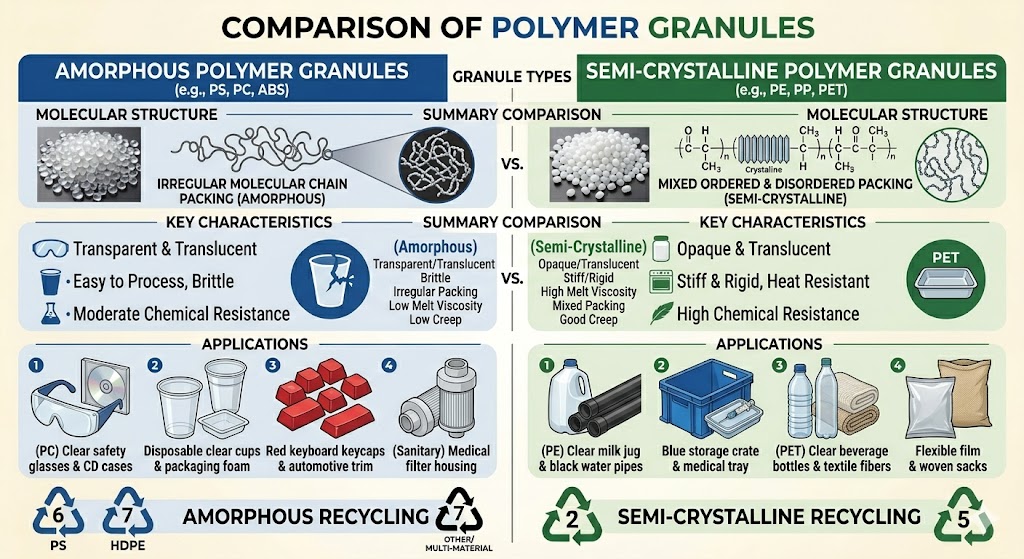
Plastic granules are small bead-like particles made from polymers. These granules are easy to transport, store, mix, and process in manufacturing machines such as injection molding and extrusion systems.
Different industries use different types of granules depending on the required performance and application.
Common plastic granules include:
- PP (Polypropylene)
- HDPE (High-Density Polyethylene)
- LLDPE (Linear Low-Density Polyethylene)
- LDPE (Low-Density Polyethylene)
- PVC Resin
- ABS Granules
- Nylon Granules
- PET Granules
Step 1: Raw Material Selection
The manufacturing process begins with selecting the required polymer raw material.
The material may come from:
- Petrochemical plants
- Virgin polymer manufacturers
- Reprocessed polymer units
- Scrap recycling plants
The type of polymer chosen depends on product requirements such as:
- Strength
- Flexibility
- Heat resistance
- Transparency
- Chemical resistance
- Impact resistance
For example:
- HDPE is used for rigid applications
- LDPE is used for flexible packaging
- PP is used for molded industrial parts
Step 2: Polymerization Process
Virgin plastic granules are generally produced from crude oil or natural gas derivatives.
During polymerization:
- Small molecules called monomers are chemically combined
- Long molecular chains are formed
- These chains become polymers
Examples:
- Ethylene forms Polyethylene
- Propylene forms Polypropylene
- Vinyl Chloride forms PVC
This stage is usually handled in large petrochemical plants.
Step 3: Melting and Mixing
After polymer production, the material is heated and melted inside industrial processing equipment.
At this stage manufacturers may add:
- Color masterbatch
- Stabilizers
- UV protection additives
- Fillers
- Processing aids
- Impact modifiers
This mixing process helps achieve the desired performance and product quality.
Step 4: Extrusion Process
The melted polymer is then passed through an extrusion machine.
Inside the extruder:
- The material is heated continuously
- A rotating screw pushes the molten polymer forward
- The material passes through a die head
- Long plastic strands are formed
Extrusion is one of the most important stages in granule manufacturing.
Step 5: Cooling the Plastic Strands
The hot plastic strands are immediately cooled using:
- Water baths
- Air cooling systems
- Cooling conveyors
Proper cooling is necessary to maintain:
- Uniform shape
- Dimensional stability
- Material consistency
Step 6: Cutting Into Granules
After cooling, the plastic strands enter a pelletizing machine.
The machine cuts the strands into small uniform granules or pellets.
These granules are:
- Dried
- Filtered
- Collected
- Packed into bags for industrial supply
The final product becomes ready for dispatch to manufacturers and processors.
Reprocessed Plastic Granules
Apart from virgin granules, many industries also use reprocessed plastic granules.
These are made from recycled plastic waste through:
- Plastic collection
- Sorting and cleaning
- Grinding into flakes
- Melting and filtering
- Extrusion and pelletizing
Reprocessed granules are commonly used in:
- Utility products
- Packaging
- Industrial reuse applications
- Cost-sensitive manufacturing
Why Granules Are Used Instead of Raw Plastic Blocks
Granules are preferred because they are:
- Easy to handle
- Easy to transport
- Suitable for automatic machines
- Consistent in size
- Faster to process
- Convenient for bulk industrial usage
Uniform granules also improve manufacturing efficiency and reduce wastage.
Industries That Use Plastic Granules
Plastic granules are widely used in:
- Packaging industry
- Pipe manufacturing
- Automotive sector
- Consumer products
- Electronics
- Agriculture films
- Household products
- Recycling industry
- Construction materials
Conclusion
Plastic granules are produced through a carefully controlled industrial process involving polymerization, extrusion, cooling, and pelletizing. These granules become the raw material for countless products used across industries every day.
Whether virgin or reprocessed, plastic granules help manufacturers achieve scalable production, material consistency, and efficient processing for modern industrial applications.