Difference Between PET and PP
PET (Polyethylene Terephthalate) and PP (Polypropylene) are among the most commonly used polymers in the plastic and packaging industry. Both materials are widely used in manufacturing, packaging, food containers, industrial applications, and commercial product development. However, PET and PP have different physical, thermal, and commercial properties that make them suitable for different industrial uses.
Understanding the difference between PET and PP helps manufacturers, converters, packaging businesses, and industrial buyers select the correct polymer according to product performance, flexibility, durability, transparency, and processing requirements.
What Is PET?
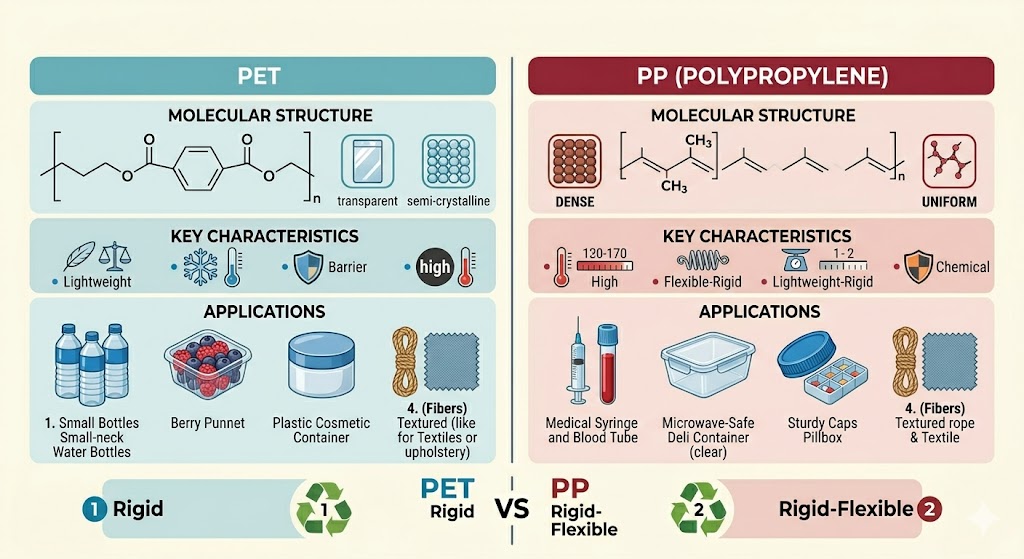
PET (Polyethylene Terephthalate) is a strong and lightweight thermoplastic polymer widely used in beverage bottles, food packaging, polyester fibers, and transparent packaging products. PET is known for its clarity, strength, dimensional stability, and recyclability.
PET is commonly used in:
- Water bottles
- Soft drink bottles
- Food packaging trays
- Transparent containers
- Polyester fiber production
- Industrial packaging sheets
What Is PP?
PP (Polypropylene) is a versatile thermoplastic polymer known for heat resistance, flexibility, low density, and chemical resistance. It is widely used in molded products, packaging, automotive components, woven sacks, and household products.
PP is commonly used in:
- Food containers
- Injection molded products
- Automotive parts
- Packaging applications
- Woven bags
- Industrial containers
Main Difference Between PET and PP
1. Transparency
PET offers excellent transparency and glossy appearance, making it suitable for clear bottles and premium packaging products. PP is generally less transparent and is often used where clarity is not the primary requirement.
2. Heat Resistance
PP has better heat resistance compared to PET in many industrial applications. PP containers are often used for microwave-safe and hot-fill products.
3. Strength and Rigidity
PET provides higher rigidity and tensile strength, especially in bottle-grade applications. PP offers a balance of flexibility and toughness.
4. Weight
PP is lighter because of its lower density. This makes it commercially useful for lightweight molded products and packaging applications.
5. Chemical Resistance
PP has excellent resistance to many chemicals, acids, and industrial solvents. PET also offers good resistance but is more commonly selected for packaging and food-contact applications.
6. Recyclability
PET is one of the most widely recycled plastics globally. Recycled PET is commonly reused in packaging, fibers, and industrial products. PP is also recyclable but has comparatively lower recycling rates in some regions.
PET vs PP Applications
| Application | PET | PP |
|---|---|---|
| Beverage Bottles | Excellent | Limited |
| Food Containers | Good | Excellent |
| Heat Resistance | Moderate | High |
| Transparency | High | Moderate |
| Injection Molding | Good | Excellent |
| Flexible Packaging | Moderate | Good |
Which Polymer Is Better?
The choice between PET and PP depends on the end-use application. PET is preferred where transparency, rigidity, and recyclability are important. PP is selected where heat resistance, flexibility, lightweight structure, and chemical resistance matter more.
Manufacturers often compare PET and PP based on processing method, packaging performance, commercial pricing, and product durability before selecting the right material.
Conclusion
PET and PP are both highly important industrial polymers used across packaging, manufacturing, automotive, and commercial sectors. PET is widely used for transparent bottles and recyclable packaging, while PP is preferred for durable molded products and heat-resistant applications.
At Granil PolyTrade, we supply quality polymer materials including PET resin, PP granules, HDPE, LLDPE, LDPE, PVC resin, engineering polymers, and reprocessed polymer materials for industrial and commercial requirements across India.
With rising demand for quality recycled plastic raw materials, trusted suppliers and traders like Granil PolyTrade help manufacturers source reliable polymer solutions across India.
For polymer sourcing, recycled plastic materials, and industrial raw material support, visit: